
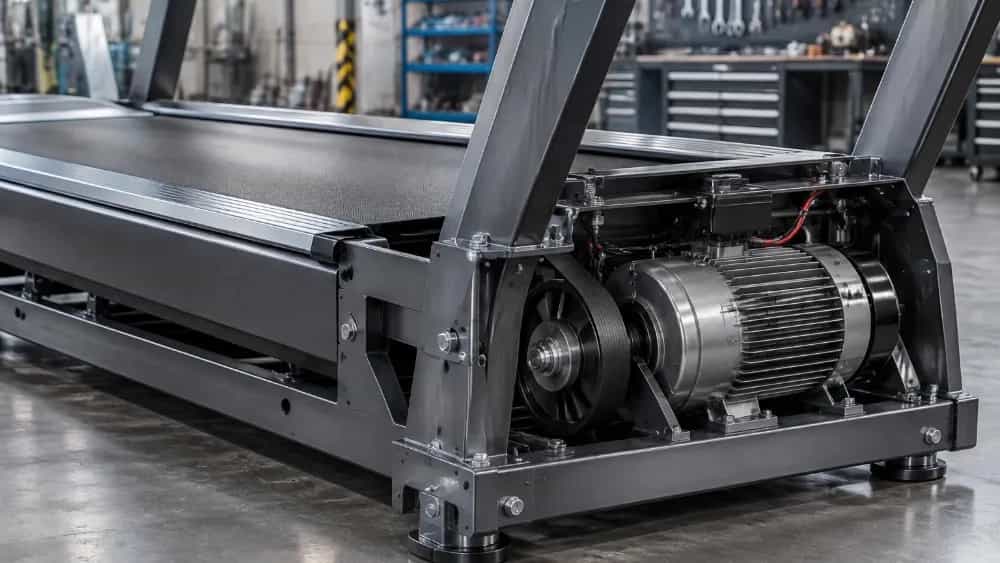
Purchasing a heavy weight gym treadmill requires choosing a device with an alternating current (AC) motor with a power of at least 4 to 7 horsepower, an all-steel body resistant to continuous shocks, and a minimum mechanical capacity of 180 to 220 kg. For the durability of the equipment in high-traffic halls, the thickness of the multilayer belt should be above 2.5 mm and its suspension system should be equipped with oil or industrial elastomer shock absorbers to prevent friction and the transmission of heavy vibrations to the chassis. Choosing the wrong device with an unrealistic capacity will lead to the burning of the inverter and the deformation of the running deck within a few months.
The structural difference of heavy club treadmills with normal models
Many buyers are satisfied only with the engraved number for carrying weight on the catalog, but in practice, it has been observed that heavy commercial treadmills have a fundamental difference in chassis engineering and electronics. Home or semi-club treadmills, even with the claim of high weight tolerance, use direct current (DC) motors, which quickly heat up and suffer voltage drop as the user's weight increases and the running continues.
In heavy-duty club models, the use of AC induction motors with industrial heavy-duty drivers and inverters is mandatory. These systems keep the speed of the conveyor belt completely uniform even under the pressure of the steps of a heavyweight athlete weighing more than 150 kg without increasing the temperature of the coil.
Critical components in determining the efficiency of a high weight bearing treadmill
In order for a treadmill to last 10 to 16 hours of continuous daily use in the gym, it is necessary to focus on the following technical specifications:
Continuous power and torque of induction motor (AC)
The real standard in gyms is Continuous Duty, not Peak Power. A real heavy machine needs at least 4 horsepower of continuous power to overcome the initial resistance of the high weights and not put too much strain on the power transmission system.
chassis and deck material (running deck)
In the field investigations of technical technicians, aluminum chassis are unsuitable for super heavy weights and they twist quickly. The chassis should be made of thick steel cans with robotic welding. Also, the deck (the board under the belt) should be between 25 and 30 mm thick and preferably double-sided with phenolic coating, so that it can be reversed after initial wear.
Industrial rollers and belt thickness
Rollers are the backbone of smooth belt movement. The larger the diameter of the roller (above 75 to 90 mm), the pressure on the bearings is reduced and the contact area with the belt is increased. The belt in this category must be made of anti-static polyurethane with a thickness of at least 3 mm so that it does not tear or come out of regulation.
Challenges of electricity fluctuation and parts depreciation in the Iranian market
Club equipment in Iran has its own technical considerations. Extreme fluctuations in the voltage of the city network and high heat in some seasons are the main causes of failure of the electronic boards of expensive and heavy treadmills.
Technical experience has shown that devices with high-quality inverters and separate motor cooling system (Dual Fan Cooling) have a much higher compatibility with the state of the electrical infrastructure of the halls. In addition, the availability of consumable parts such as standard inverters, speed sensors and belts with conventional dimensions in the market prevents the device from grounding after long periods of service.
Common mistakes when choosing equipment for gyms
One of the common mistakes of salon managers is choosing a device based on a large touch screen instead of checking the gearbox, roller and frame. Smart digital options are of no operational value if the device cannot absorb the impact pressures of fast running heavyweights. The focus of investment should be directly on structural endurance, ease of automatic lubrication and quality of mechanical suspension system.